


Some sounds need no explanation. Hear them just once and something stirs within: a sunlit plaza at dusk, a dress spinning, hands beating time against the warm July air. Castanets speak like that, without words. They tell stories of celebration and roots, of restrained emotion and bursting joy. They are rhythm, identity and memory. They are, perhaps, the most authentic sound of Spanish culture.
What are castanets, really?
Castanets (also called palillos in Andalusia or crótalos in academic language) are an idiophonic percussion instrument: the sound is born from the material itself, with no strings or membranes. Two concave shells, joined by a cord, strike against each other driven by the fingers.
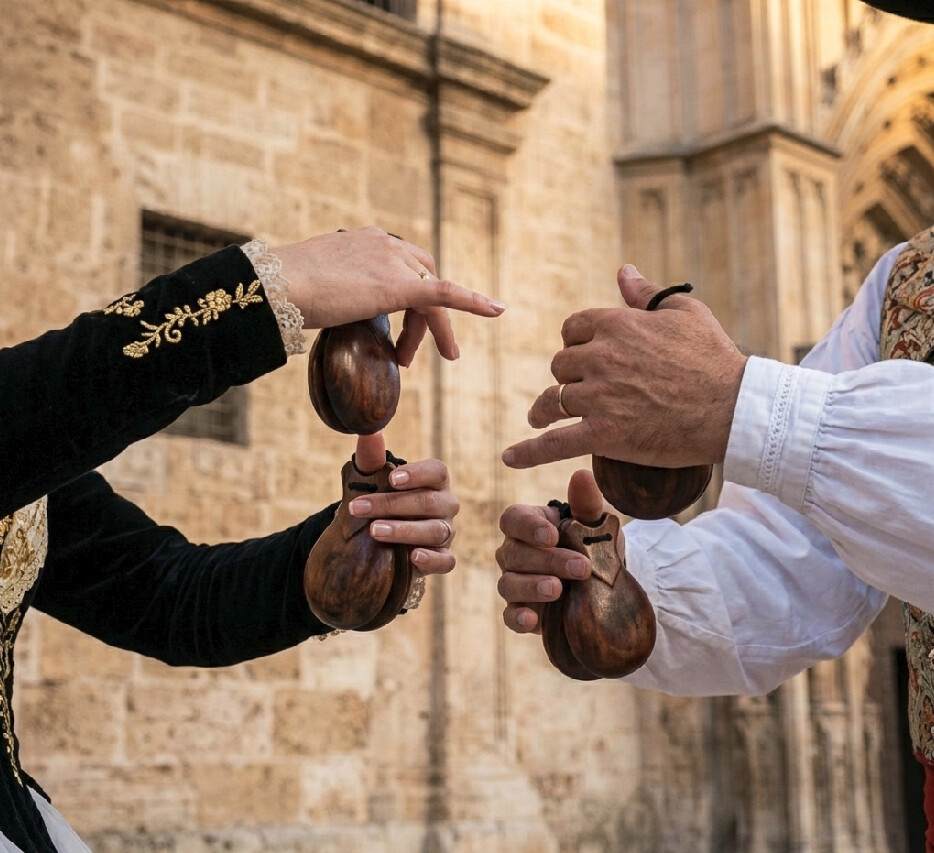
Each piece has its parts: the shell, the resonating body; the ear, an extension that serves as a grip; and the bridge, the contact zone where the strike occurs. The cord holds them against the thumb, leaving the remaining fingers free to play.
They always come in pairs, but they are not alike. The female, marked with a notch on the ear, has a higher pitch and is worn on the right hand: it draws the rhythmic melodies. The male, with a deeper sound, sits on the left and keeps the pulse. Together, they form a dialogue between brightness and depth.
They are crafted from woods such as ebony, granadillo or rosewood, as well as pressed cloth or fibreglass.
The language of rhythm: how they are played
Playing castanets is harder than it looks. The cord is secured to the thumb and the remaining fingers strike the shell in precise sequences, producing anything from rapid rolls to dry, forceful clicks.
The right hand takes the lead: it performs the carretillas, those swift rolls that mimic a trill. The left hand responds with spaced beats that sustain the tempo. Coordination between both hands is everything. A skilled touch transforms the instrument into an extension of the body.
Technique changes the sound entirely. A gentle tap produces a quiet click; a vigorous carretilla fills the entire room.
Where they sound: uses in dance and tradition
Castanets are inseparable from flamenco and sevillanas. They accompany palos such as fandangos, guajiras, caracoles and seguiriyas. Carmen Amaya was the one who fully explored their rhythmic richness within flamenco, bringing them a prominence they had not held before.
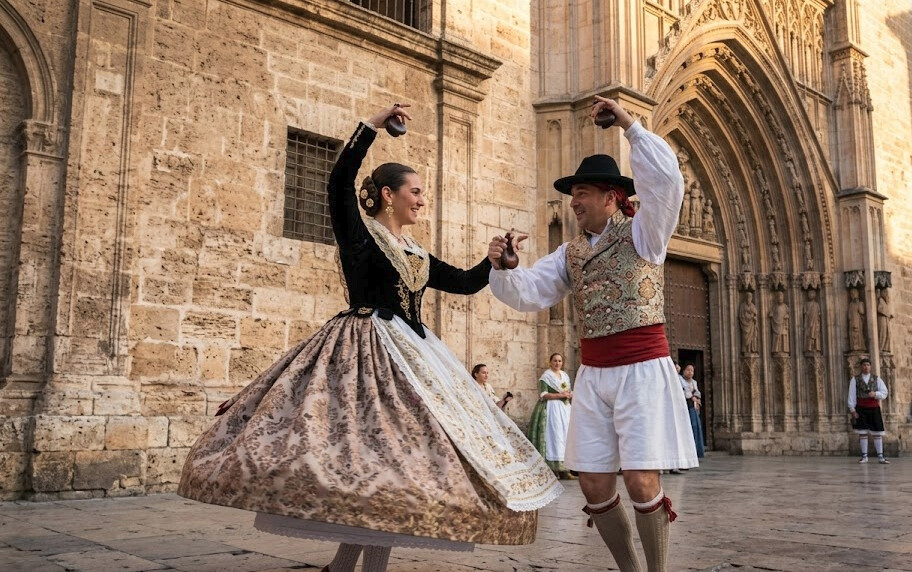
But their presence extends well beyond Andalusia. In Aragon, the dancers of Jaca perform the traditional castanet dance before the shrine of Santa Orosia, dressed in white with sashes and bells, in a tradition documented since 1650. In Valencia, the Danses keep three artisanal models alive (La Font de la Figuera, Xàtiva and Morella), carved from local woods such as apricot root or holm oak heartwood.
At pilgrimages and patron saint festivals across Spain, castanets mark the collective step. They are the thread that connects those who dance with those who danced before.
More than an instrument: tradition and expression
Castanets carry over three thousand years of history. The Phoenicians used them in religious ceremonies and spread them across the Mediterranean. In Spain they found their lasting home. Before accompanying dance, they sounded in classical music: Boccherini, Wagner and Joaquín Rodrigo wove them into their compositions. The Bolera school was the bridge that carried them from the concert hall to the dance stage.
Concert soloists such as Lucero Tena (to whom Rodrigo dedicated his Dos danzas españolas) or Emma Maleras, who developed a study method comparable to that of any academic instrument, proved that castanets deserve a place in the great halls. Meanwhile, craftsmen like Fernando Belda and José Franco Murillo continue to carve them by hand, resisting industrial uniformity.
The echo of an identity
Castanets are not relics of the past. They are a living sound, reinvented in every hand that learns to play them. They hold within them centuries of festivals, stages, crowded plazas and quiet afternoons of practice.
To hear them is to recognise something of your own. To play them is to continue a conversation that began three thousand years ago and that, as long as someone is willing to hold them between their fingers, need never end.